Last updated: September 2026
When you are booking your first campsite, the site descriptions can read like a checklist in a foreign language: W/E/S, 50A, FHU, dry, back-in. Once you know the code, it takes about ten seconds to evaluate a site. Until then, it is easy to book the wrong thing and arrive without power or water. This guide translates every hookup term for first-timers.
Electric Service: 30-Amp vs 50-Amp
A 30-amp site provides a single 120V leg at 30 amps — about 3,600 watts of total available power. That is enough to run one air conditioner, your refrigerator, the microwave, and your lights, but not everything at once. Most travel trailers, small Class C rigs, and older motorhomes are built for 30-amp service.
A 50-amp site provides two 120V legs at 50 amps each — effectively 12,000 watts. That is enough to run two roof air conditioners simultaneously, the electric water heater, the washer/dryer, and everything else at the same time. Larger Class A and Class C motorhomes, most fifth wheels over 28 ft, and luxury travel trailers are typically 50-amp rigs.
The physical plugs are different. A 30-amp plug has three prongs (one hot, one neutral, one ground). A 50-amp plug has four prongs (two hots, one neutral, one ground). You cannot plug a 50-amp cord into a 30-amp outlet without an adapter.
Adapters
Every RVer should carry both a 30-to-50-amp adapter and a 50-to-30-amp dogbone adapter. The 50-to-30-amp adapter lets you plug your 50-amp RV into a 30-amp site — your rig runs fine but with limited power. The 30-to-50-amp adapter lets a 30-amp rig plug into a 50-amp site and works perfectly, with no wasted capacity.
A surge protector pedestal ($60-$150 depending on amp rating) sits between the campground power supply and your RV and protects against voltage spikes, miswired pedestals, and low-voltage conditions. It is not optional equipment for anyone camping more than a few times a year.
As of 2026, most new RV park developments are installing 50-amp service as the default. 30-amp sites are increasingly reserved for smaller rigs and tent campers at mixed-use campgrounds.
Water
Water hookup means you connect a drinking-water-safe hose from the pedestal spigot directly to your RV city water inlet. Once connected, your RV plumbing works continuously — no need to pump from your fresh water tank. Always use a white or blue hose rated for drinking water, not a standard green garden hose, which can leach chemicals.
Always use an inline water pressure regulator. Many campground spigots operate at 80+ PSI, which exceeds what most RV plumbing systems are rated for (typically 40-55 PSI). A regulator screws directly onto the spigot and runs about $10-$20. Skip it and you risk blowing out fittings and connections.
Sewer
Sewer hookup means your site has a sewer inlet where you run your drain hose from the RV black and gray tank dump outlets. With a sewer hookup you can leave your tanks connected and drain continuously, rather than driving to a dump station when the tanks fill.
Critical rule: keep your black tank valve closed until you are ready to dump. Never leave the black tank valve open while connected. Without a full tank to flush waste down the pipe, solids accumulate and create what is known as a "poop pyramid" — a calcified mass that is genuinely difficult to remove. Your gray tank valve can stay open to drain continuously, since it is only soapy water.
Your sewer kit should include a 20-ft drain hose, a 90-degree elbow fitting, and disposable gloves. A spray bottle with diluted bleach in the storage bay makes cleaning the hose fitting after every dump easier.
Hookup Combinations
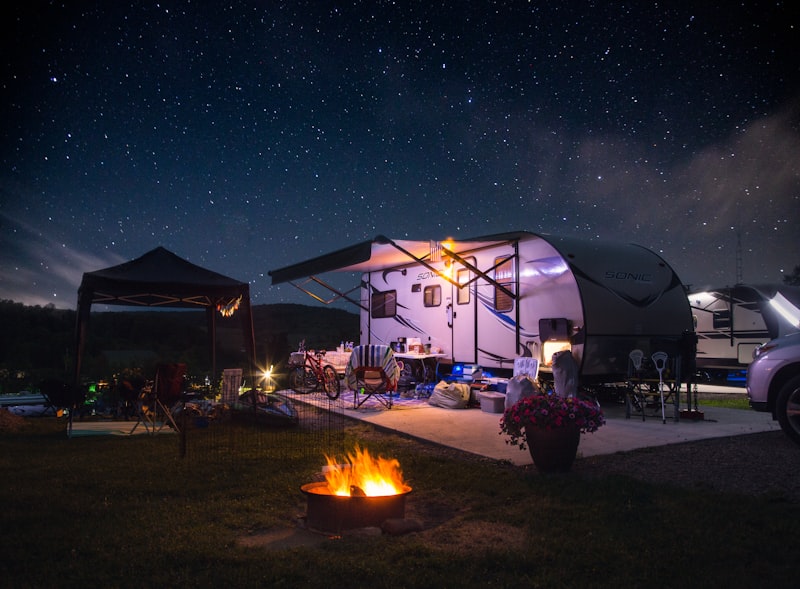
Full hookup (FHU / W/E/S): Water, electric, and sewer at the site. The default for full-timers and longer stays. No need to move the RV, manage tank levels carefully, or find a dump station.
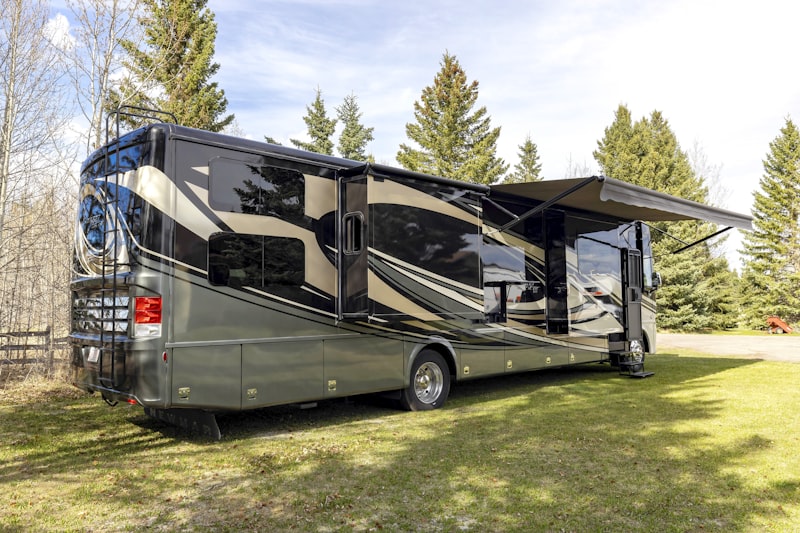
Water and electric (W/E, partial hookup): Water and electric but no sewer. You will need to manage your tank levels and use a dump station when they fill. Common at state parks and older campgrounds. For a weekend trip, holding tanks are typically large enough that you will not need to dump for 2-3 days.
Electric only: Some sites at older state parks offer only electric service. You supply your own water from your onboard tank and dump at a station when needed.

Dry camping / boondocking: No hookups. You run entirely on your onboard systems — battery bank and/or generator for power, fresh water tank for water, holding tanks for waste. Popular on BLM land, national forests, and some private parks with primitive sites. A well-equipped RV with solar panels and a large battery bank can comfortably dry camp for a week or more.
Winegard cellular and Wi-Fi boosters help maintain a reliable signal at campgrounds with weak coverage — useful whether you are working remotely or just streaming at the end of a long travel day.
Filter by hookup type, amp service, and more across 9,400+ parks.
Frequently Asked Questions
RVSpot may earn a commission from purchases made through some links on this page, at no additional cost to you.